
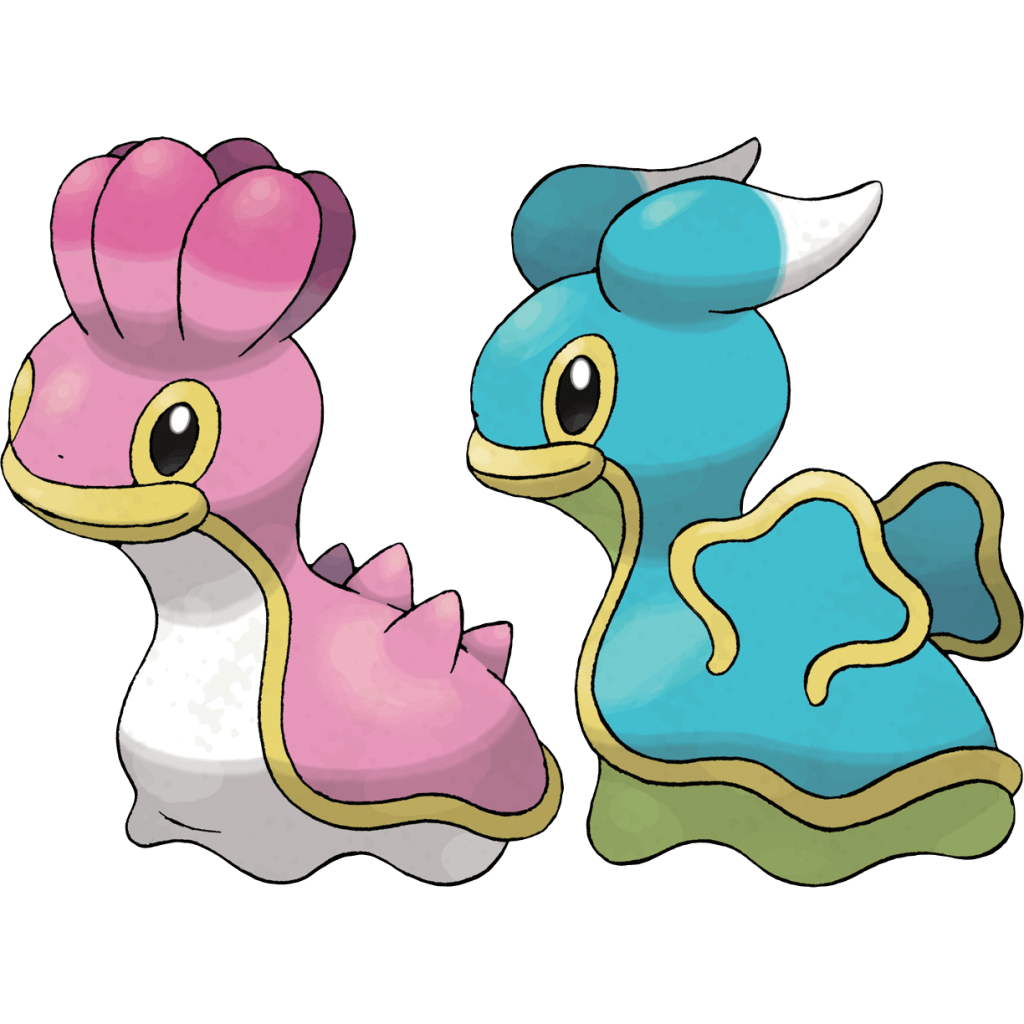
I’ll circle back to the obvious disparity between these two in a moment, but let it be said that I kinda just like these two. As wildly inventive and cool as a lava-slug was, I like these two as low-key nudibranch slugs just knocking around – and yes, there’s a whole order of slugs named nudibranchs because of their lack of shell. You even have one that’s a little more terrestrial with its more protected shell, and a softer-looking one with fins for swimming about.
Visibly-bulbous lips are a huge thumbs-down for me in most character designs, and it’s a doubly-confusing inclusion here considering that slugs don’t have much of a mouth at all. But hey, this is hardly the wildest liberty the series is taking with slug anatomy, so I’ll take it. Cute little pair, these two, especially love the differing head ornamentations here.

Unfortunatley the pair really mellow out when they mature, going for more muted colors and a lot less separation in the bits-and-bobs hanging off their bodies. A bit of a shame that we’ve lost some vibrancy here, but hey, they get this wacky third eye in the middle of their heads despite not being remotely Psychic-type, which definitely speaks to invertebrates’ wacky biology.
Also unfortunate is that these make another slow-moving Water/Ground type, which means they’re going to have to tank a lot of hits and absolutely shrivel up in proximity to flowers. Luckily they are built to take those hits, and have a strong enough movepool that they’re very usable in main campaigns where you can recall them very easily against Grass-types. Plus, they can naturally learn Recover in most games, giving them great staying power in a campaign where you’re so often fighting many many opponents in a row. Defensive Pokémon aren’t always exciting, but Gastrodon stands out among them as a surprisingly good anchor for an in-game team.
It’s pretty easy to look at pink-and-blue variant creatures – especially in Diamond & Pearl‘s introduction of sexual dimorphism – and assume that these two designs are a clean male-female split. The series has certainly done it before, and even with the “pink-and-blue” presumption reversed.
But no – these are variants based on ecology, with the pink-and-white form naturally inhabiting the Western half of Sinnoh’s continent, and the blue-and-yellow form coming from the Eastern half. It’s a nice little way of knocking on the same door as Darwin’s finches, so we should expect to see a bit of the landscape reflected in their appearances and features, right?
Well, the designs do deliver on this to an extent! The Pink variants have a bit more of a spiky back – possibly a decoy considering that neither of these are shelled slugs, but it’s an effective display nonetheless. Considering what their above-ground predators would be, it makes as much sense as a land adaptation as the finny protrusions make for the more ocean-attuned Blue variants. And, wouldn’t you know it, most of Sinnoh’s explorable shoreline happens to be on the East coast where Blue Shellos are found. Nice and clean.
It’s fun to wonder how this would have played out in Hoenn, since this familiy was originally planned for Ruby & Sapphire. That region may not have the same clear divide bisecting as Sinnoh does with Mount Coronet, but the river east of Mauville that impedes the player for the first half of the game would still make a clean divider. On one side, the more tropical Fortree and the open sea; on the other, the more aggressive Mt. Chimney and even a quick jaunt across the coast to Dewford.
That still obviously favors the Eastern variant, what with Hoenn’s many open-water routes shoved into the back half of the adventure and especially the use of Dive in the Eastern ocean. But perhaps that’s not even to their detriment; . Perhaps the Eastern Shellos would be more prevalent in the Aqua-dominated Sapphire, and the Western Shellos dominating the land-focused Ruby? That might also push a clearer divide between the two as representing proper sea-slugs and nuidibranches more attuned to brakish water.
…or you can equally refer to Scarlet and Violet to see where this line of logic would go. For all its eco-punk-inspired design, Pokémon is decidedly fuzzy in its “live with nature” messaging. The Pokédexes tend to get to stretch their legs more, though, noting that the Pink Western Shellos are more common nowadays, with Eastern Blue Shellos on the decline. Not bad on its own, but it steadily gets worse when cross-referenced with Generation VIII, which observes that Eastern Blue Shellos are more attuned to – possibly even caused by – inhabiting colder waters.
Yes, warming seas in the Pokémon world are explicitly killing off Eastern Shellos.
It’s a shame this isn’t backed up by the games’ actual ecology, where Eastern Shellos consistently inhabit more explorable area than the Western variant in modern games, but hey. At least it’s lip service.
On a more fun note – arguably more fun than the Corsola-like protrusions on Gastrodon’s early design – is this pair’s association with oxen. The two keep showing up in promotional art based around bovine Pokémon, including a Year of the Ox spread. A very left-field inclusion, until you start looking at the source of much linguistic double-meaning: kanji.
In the English language, a “sea cow” is slang for a manatee dugong. And it follows – large, mainly docile sea mammals would naturally get compared to one of the more common large, mainly docile livestock mammals. But the common Japanese word for a sea slug is umiushi, literally “sea cow”, not even as slang. To the best of my admittedly-quick referencing, it seems to come from how Dorididae, the genus more common in eastern Asian oceans, are generally more cleanly shaped and colored, which makes their feelers stand out more and invites more comparison than other, wackier forms of slug might – and with no native species of, say, rabbit to make a closer comparison to, cattle seem to have just gotten lucky.
So, back in-Pokémon-universe, this also explains the pair’s more modest “ears” in their fully-evolved form: they’re meant to be very fleshy fascimilies of bulls’ horns. Recognizable at a glance? Not especially to my eyes. But a neat little bit of trivia? That’s what gives these designs their depth.
Also, I find it important to note that the Shellos who appear in Diamond & Pearl‘s Super Contests are named “Sluggo”, “Wiggy”, and “Zoomer”: all inscrutable, perfect nicknames.
Nudibranch slugs are so famously outlandish in their appearance – nicknamed everything from “clown” to “splendid” – that I’d gladly take a new form of Gastrodon for every new ocean in the Pokémon world. Still, I can absolutely see why they didn’t – having to maintain new forms of Shellos and Gastrodon for every new region would be untenable and feed directly into the series’ ongoing scope creep problem.
Gameplay-wise, they’re not every exciting, but storytelling-wise, a simple ecological dichotomy does wonders. For how popular they don’t seem to be with fans, edging them more toward a Reserve curiosity, it’s little wonder that the series itself sees them as a Must-Have, as these two haven’t missed a game since X & Y.
Any and all appreciation for Shellos and Gastrodon is welcome in the comments!
The Ocean Conservancy is a long-established, non-profit environmental advocacy group with a wide-reaching mission including combatting the man-made climate change that threatens actual nudibranch species, and which has made substantial contributions to environmental justice legislation in the United States.
 Dextraneous
